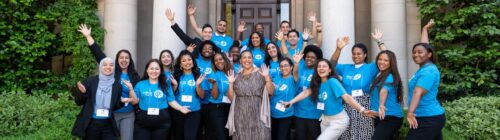
At the start of the new year, College Track sat down for a conversation with Dr. Shirley M. Collado, our President & CEO. Dr. Collado has led College Track since 2022, joining our organization after a successful career in higher education as a leader and educator, including serving as the ninth president of Ithaca College.
A first-generation college graduate herself, she sees a future filled with hope and promise for College Track’s scholars and young people around the country who dream of being the first in their family to earn a bachelor’s degree.
1. Dr. Collado, what are you excited about in 2026 for College Track?
Shirley Collado: This is going to be a major year for College Track, and two big initiatives come to mind.
This year, we are opening our 13th location, in Baltimore, Maryland, which is the result of an unprecedented partnership between an NFL team—the Baltimore Ravens, a nation-wide financial institution in M&T Bank, and our national nonprofit. The Baltimore Ravens College Track Center is our third location on the East Coast.
I see our presence in Baltimore as a local initiative with national implications. Locally, we are building an educational ecosystem across K12, higher education, and the workforce. Nationally, we are demonstrating to cities across the country how an environment can be intentionally created where young people can realize their biggest dreams.
The second area of focus I’m excited about this year is the ongoing refinement of our 10-year program. College Track began in 1997 as a college access program, and today we span high school, college, and our scholars’ transitions into their careers or graduate school. Evolution and an obsession with student success is in our DNA.
In 2026, we are encountering a shifting higher education landscape, the emergence of AI, and the changing face of the future of work in this country. This means we must be nimble and allow space for innovation if we are to continue to serve our scholars in the ways they will find most beneficial for their education, careers, and dreams.

2. What momentum from 2025 is College Track building on?
Dr. Collado: 2025 was a pivotal year, not just for College Track, but for our nation. Our North Star has been and always will be to democratize potential: dedicating ourselves wholly to the idea that any young person can learn when they are in an affirming environment that meets them where they are. Deeper still, we believe that any young person who wants to attend college should be able to do so in a way that is affordable and facilitates a pathway toward a meaningful career and a purposeful life.
In this context, last year brought great momentum for us. It saw our network of college and university partners expand to 20—and in 2026 we’ll welcome additional institutions. It saw us strengthen our data-driven practices and culture, which furthers our ability to support the success of every one of our scholars. It saw us build our thought leadership in first-generation student success, with the goal of becoming a world class resource for anyone who wants to create the right conditions for a student to become the first in their family to earn a bachelor’s degree.
I want to take a moment, too, to express my gratitude for the support and partnership we received in 2025 from our dedicated stakeholders and supporters. Collaboration is essential to the work we do, and the broader College Track community is a big part of our momentum going into 2026.

3. As you reflect personally on the past year, what did 2025 teach you about education as a force for financial, professional, and social mobility?
Dr. Collado: As the first person in my family to earn a bachelor’s degree, College Track’s mission represents my life’s work—and shows what is possible when we believe in young people.
For many of our scholars, and for many young people in this country, earning a bachelor’s degree is a political and a radical act. Research continues to confirm that it is the most powerful lever for an individual, and by extension, for their families and for communities, to activate mobility in our society. That’s why College Track focuses on access to an affordable four-year degree.
Last year, I was reminded of this so powerfully through the journey of College Track alumna, Jaela Caston. Jaela was one of the first alumni I had the opportunity to connect with when I began my role at College Track. At that time, she was beginning her doctoral program in biomedical science at the University of California San Francisco, navigating a space that was not built for her success—the success of young Black women in STEM.
The past four years have seen Jaela not only excel, but intentionally create community and visibility that results in a sense of belonging for young women and people of color who come after her.
In 2025 we heard the fantastic news that Jaela received the prestigious Howard Hughes Medical Institute Gilliam Fellowship—one of 30 recipients out of a pool of 800 applicants. She’s doing cutting edge research in neuroscience, and is an important talent who will continue to contribute greatly to our shared humanity.
Jaela is one of thousands of young people across the nation whose talent must be met with opportunity. That is our responsibility as a society and we will be the better for it.


4. As we start 2026, what does the higher education landscape look like?
Dr. Collado: We are undoubtedly at an incredible crossroads in the history of American higher education. This is a moment where we’re seeing an increasing mistrust of this sector among Americans and a breakdown in the perception of higher education as a pillar of the common good. We have a lot of work to do to reimagine the future of higher education in a way that restores trust and transforms this system to be more accessible and more clearly connected to individual success and the broader success of our country.
In any moment of drastic disruption, we see the emergence of innovation to support a new beginning. That is true right now for higher ed. I believe we can lean into this moment in a way that creates community by leveraging unexpected partnerships, creates clear integrated pathways between education and meaningful work, and fiercely protects the value of a liberal arts education.
From my conversations with colleagues around the country, I know there is an appetite to unite on behalf of our nation’s future and the young people who hold it in their hands.
5. What new challenges and opportunities do first-generation college students and young graduates face in 2026?
Dr. Collado: Right now, as the next generation is preparing to emerge fully into our society, there is a bleak narrative about the scarcity of jobs, the perceived threat of technology and innovation, and the pace of change. It’s a lot of doom and gloom—and I find that incredibly short sighted because I believe this is a moment for first-generation college students to shine.
Students who are now in high school and college will reimagine their careers many times throughout their lives and must be prepared to leverage tools, resources, and confidence to chart their own course.
First-generation college students are uniquely positioned to thrive in this new world. Many join campus communities already balancing jobs, caregiving responsibilities, and financial obligations. They have incredible persistence and drive.
When you combine these “superpowers” with access to a balanced education that is rooted in the liberal arts and deeply versed in STEAM fields, a welcoming campus community, meaningful internships, and an intentional network of peers and mentors—our students join the workforce ready to shape the future.
6. And finally, Dr. Collado, what message would you like to share with the College Track community as we begin the new year?
Dr. Collado: College Track is blessed to have a community that includes not just scholars, alumni, families, and staff, but donors, public officials, college presidents, entrepreneurs, business leaders, artists, innovators, athletes and beyond. We are deeply connected by our strong hope for the future and our unshakeable resolve that all people are entitled to a life of agency and purpose.
When I think about this community, I am filled with gratitude for the opportunity to do my life’s work alongside others who have such heart and generosity of spirit.
College Track’s work responds to the deep need for our nation to uphold the promise of the American Dream. I’m proud of how we show up in this pursuit and I have a tremendous amount of confidence in this community—in our ability to adapt, learn, improve, and stay the course—no matter the headwinds.
About Dr. Shirley Collado

Shirley M. Collado, Ph.D., has been the president and chief executive officer of College Track since January 2022. Shirley has led the organization through the redesign of an evolved 10-year program, a robust college and university partnership strategy—now in its third year and numbering 20 partner institutions, the development of national and local cross-sector relationships that create an ecosystem for first-generation student success, and a shifting national landscape.
A recognized higher education leader, Shirley has committed her professional life to unlocking practical but accessible routes for first-generation students to realize their full potential. A barrier-breaker herself, Shirley was the first in her family to earn a bachelor’s degree more than 30 years ago and went on to become the ninth president of Ithaca College—and its first president of color—as well as the first Dominican-American to lead a four-year institution in the U.S.
Before joining College Track, Shirley held key leadership roles including Executive Vice Chancellor and Chief Operating Officer at Rutgers University-Newark, Dean of the College and Vice President for Student Affairs at Middlebury College, and Executive Vice President of The Posse Foundation.