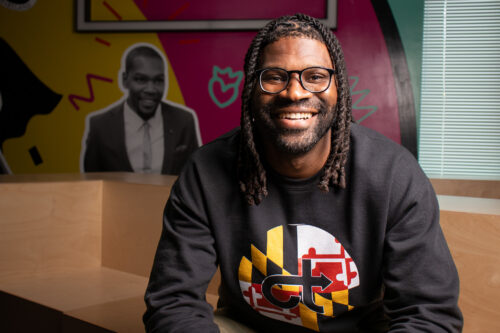
Ask James Williams how he sees College Track, and he describes a runway. Our scholars are the planes, he says. They arrive with everything they need to take flight, and our job is to help guide them to a successful takeoff. Now, in a new role as College Track’s first Executive Director, Maryland, James brings that philosophy to both our Baltimore and Prince George’s County centers, uniting them as one Maryland College Track community. A first-generation college graduate, he knows firsthand that the path to success doesn’t always run straight. Here, James talks about the setbacks that shaped him, the scholar who changed how he sees this work, and why he hopes Baltimore families will light up when they run into him at the grocery store.
Tell us about yourself. Where did you grow up, and what shaped who you are today?
I’m originally from South Carolina, but my formative years were spent here in the Washington, D.C. metro area, long before the term “DMV” became part of our everyday vocabulary.
A lot of who I am is rooted in my family’s story. I’m one generation removed from sharecropping. My grandfather worked incredibly hard to provide for his nine children, and one of the things he left behind was land where my father and his siblings eventually built their homes. That taught me a great deal about sacrifice, generational opportunity, and what it means to create something that benefits the people who come after you.
Neither of my parents had the opportunity to complete college, so becoming the first in my family to do so was incredibly meaningful. I also played football in college, which taught me accountability and the importance of putting something bigger than yourself first. When I think about what shaped me, it all comes back to hard work, sacrifice, education, and a commitment to creating opportunities for others.
Walk us through your career before your current role. What experiences prepared you to lead at College Track?
My career began in college, when I was introduced to community service and began to understand how interconnected systems can contribute to the disenfranchisement of certain communities. One thing stood out to me: the people receiving services often didn’t look like the people administering them. I made a commitment to be part of changing that.
That commitment led me to work in public housing communities throughout Northern Virginia, helping families access resources, running after-school programs, and leading youth programming recognized across the state. Those experiences taught me that relationships matter. Regardless of our backgrounds, we want many of the same things: safe communities for our families, great schools for our children, and opportunities to build better lives for the next generation.
From there, I spent much of my career in national workforce development, where I learned to balance an organization’s core mission with the flexibility local communities need to shape how that mission comes to life. Before joining College Track, I was responsible for operations in both Washington, D.C. and Baltimore, which taught me firsthand that relationships cannot be taken for granted, and that how you communicate change is just as important as the change itself.
Coming back to Baltimore through College Track, including our presence at the Druid Hill YMCA, is an opportunity to strengthen community trust and ensure Baltimore families have a partner they can count on. That’s what leadership at College Track means to me: building relationships, earning trust, creating opportunities, and keeping the success of our scholars at the center of everything we do.
What first drew you to College Track, and what keeps you committed to this work?
What first drew me to College Track was the opportunity to be part of an important moment in its evolution. I saw a strong national program model and the chance to bring everyone together around it, so young people receive a consistent, high-quality experience wherever they participate.
There was also a deeper connection, rooted in my experience in workforce development. Throughout my career, I’ve seen young people who entered the workforce without bachelor’s degrees encounter glass ceilings that limit their ability to advance. That reinforced something I’ve always believed: A college degree can be a powerful vehicle for economic mobility.
For me, this work is ultimately about economic justice. It’s about ensuring that a young person from an underrepresented community can earn a college degree, change the economic trajectory of their family, and return to reinvest in their community. Imagine what West Baltimore could look like. Imagine what Suitland, Maryland, could look like when generations of young people have that opportunity. That’s what keeps me committed to this work.
Think back to your own path after high school. What do you know now that you wish someone had told you then, and how does that shape the way you lead?
In full transparency, I probably wasn’t ready for college at the time. Football provided structure, but I still struggled with time management, focus, and balancing my academic responsibilities. I was placed on academic probation multiple times and on academic suspension twice. It wasn’t a question of ability or potential. It was a matter of developing the habits and discipline to succeed.
What made the difference was having people around me who believed in me. A faculty member advocated for me and helped me move into Interdisciplinary Studies, and the dean of my new program had a very grown-up conversation with me about expectations and accountability. By then, I was working full-time and paying rent, but those remaining semesters were some of my best academically. I made the Dean’s List.
If there’s one thing I wish someone had told me earlier, it’s that your path doesn’t have to look like everyone else’s. You may need to take a different route, ask for help, or make adjustments along the way. None of that means you lack the ability or potential to succeed.
That experience has fundamentally shaped how I lead. I try to lead from a place of empathy, because everyone has a story, and we don’t always know what it took for someone to get where they are today.
What has leading the Durant Center taught you about what scholars need to finish college, not just start?
Academic preparation is essential, but it’s only one part of the equation. Scholars also need critical thinking, self-advocacy, grit, and resilience. They need to know how to navigate setbacks and ask for help. And just as importantly, they need trusted adults in their corner who can coach them through difficult moments and remind them of what they’re capable of when things don’t go as planned.
The other critical piece is career exposure. I don’t think we should mince words about this: Our young people are going to college to prepare for careers and to create access to sustainable employment and livable wages. It’s not enough to tell scholars to pursue internships or build professional networks. Alongside our partners, we have to help make those connections possible.
Ultimately, success isn’t simply getting a young person into college or even helping them graduate. It’s turning educational opportunity into lasting economic mobility.
Tell us about a scholar whose journey changed how you think about this work.
I immediately think about Lamar, who is now a sophomore in college. During his time in our college readiness program, Lamar was committed to doing the work, but he was very much about his business. He wasn’t someone who openly shared what was happening beneath the surface.
When we welcomed Lamar back to our site this past year, the light that surrounded him was incredible. He shared that during those years, he was navigating the darkness of his circumstances. With time and perspective, he could now recognize the light our staff had consistently shown him every day, and he wanted to return that light to others. He’s committed to coming back to share his story with other College Track scholars, including how changing his mindset changed his ability to succeed in college.
That conversation reminded me that so much of our work will never show up on a lesson plan or program metric. Some of our greatest impact happens in everyday moments: how we show up for young people, hold them accountable, and keep believing in them even when they don’t yet believe in themselves. Sometimes young people don’t recognize those moments until much later. And that’s okay. Our responsibility is to keep showing up.
What do people most often misunderstand about first-generation college students?
People often misunderstand the difference between a handout and a hand up. There’s sometimes an assumption that these young people need someone to give them something they don’t already possess. I see it very differently.
I think of College Track as a runway for success. Our scholars are the planes. They come to us with tremendous potential and everything they need to take flight. Our job isn’t to fly the plane for them. Like air traffic control, we help them navigate, adjust when they veer off course, and ensure they have the right conditions for a successful takeoff.
Our scholars don’t lack the ability or the potential to be successful. What they may lack is access to resources, relationships, information, and opportunities that other students have had for generations. Our responsibility is to help close those gaps.
We aren’t creating their potential. We’re helping create the conditions for that potential to take flight. And ultimately, they’re the ones in control of where they go.
What does leading across both centers make possible for scholars and families?
I think about one village: the Maryland College Track village. Within that village, we have two homes. Each home has its own personality and culture, but we’re one community, united by the same mission and commitment to our scholars and families.
That matters to our college partners throughout the region, including Bowie State University, American University, UMBC, and St. Mary’s College of Maryland. I want them to recognize that they’re not simply welcoming a scholar from Baltimore or Prince George’s County. They’re welcoming a Maryland College Track scholar, with the same quality of preparation, support, and expectations, regardless of which location that scholar calls home.
Our locations may differ, but our commitment, our standards, and the quality of experience we provide should be consistent. I want the strength of one location to make the other stronger, so every scholar benefits from being part of that larger village.
Johnel Trammell and Dionn Brown, Ed.D., are stepping into expanded roles as Directors of Programs. What does each of them bring, and how will the three of you lead together?
I’m incredibly excited about the strengths each of them brings. Johnel has been part of the Durant Center since its founding and has seen it evolve through every stage. That institutional knowledge will be instrumental as we build a strong foundation for Baltimore and the systems for long-term success, from supporting scholars through high school and college to building a thriving alumni community.
Dionn brings a deep understanding of Baltimore, a commitment to the community, and an extensive network of relationships that will strengthen our local ecosystem of partners. She also brings valuable experience in staff development and coaching, which will be critical as we build our Baltimore team and help them understand what it means to represent Charm City.
Strong leadership means understanding where others bring strengths that complement your own. I don’t have to be the best at everything. My responsibility is to recognize the talent around me, empower our leaders, and keep us grounded in our shared commitment to the success of our scholars.
For Baltimore families meeting you for the first time, what do you want them to know about you?
First and foremost, I am committed to you and your young people. Their success is not just part of my job; it is my priority and my responsibility. And that commitment extends to your whole family and the future you’re working so hard to create for your children.
I often describe my role as barrier reduction. My responsibility is to identify what may be getting in the way of your young person’s success, whether that’s access, resources, communication, or navigating unfamiliar systems, and make that journey as smooth and supportive as possible. I want you to feel welcomed, heard, respected, and confident that the people surrounding your young person genuinely care about their success.
Imagine watching your young person walk across the stage at their high school graduation, then a college graduation stage, and into a career filled with opportunity. When you look back on that journey, I want you to know College Track was a partner you could count on, and that our commitment didn’t end when they graduated.
That’s the promise I want to make to Baltimore families, and it’s a promise I intend to work every day to deliver.
A year from now, what will tell you this first chapter has gone well?
A year from now, the measure of success for me is simple. When I run into a family in Baltimore, whether it’s at the grocery store or at Mondawmin Mall, I want them to light up and say, “Hey, Mr. James, it’s so good to see you.” I don’t want them ducking down an aisle because we didn’t keep the promise we made to them and their families.
That trust won’t be an accident. It will show up in the work: our first scholar class on track academically, strong engagement from scholars and families, and a team in place that knows Baltimore and is invested in it. If we see those things, I’ll know we kept our promise.
That promise is why I’m here.
Ten years from now, what do you hope College Track scholars in Maryland will say about their experience?
Ten years from now, when College Track scholars in Maryland look back on their experience, I want them to smile. I want them to remember what it felt like to be supported, to be seen, and to be invested in by people who saw their potential as limitless, even when they couldn’t yet see it themselves.
And when things got hard, I want them to remember that they had a place and people they could count on to help them get back on track. I hope they say, “College Track believed in me before I believed in myself,” and that it helped them soar higher than they ever imagined when they started this journey at 14 years old.
It starts with families who are glad to see us, and it ends with scholars who are glad they were part of this.